


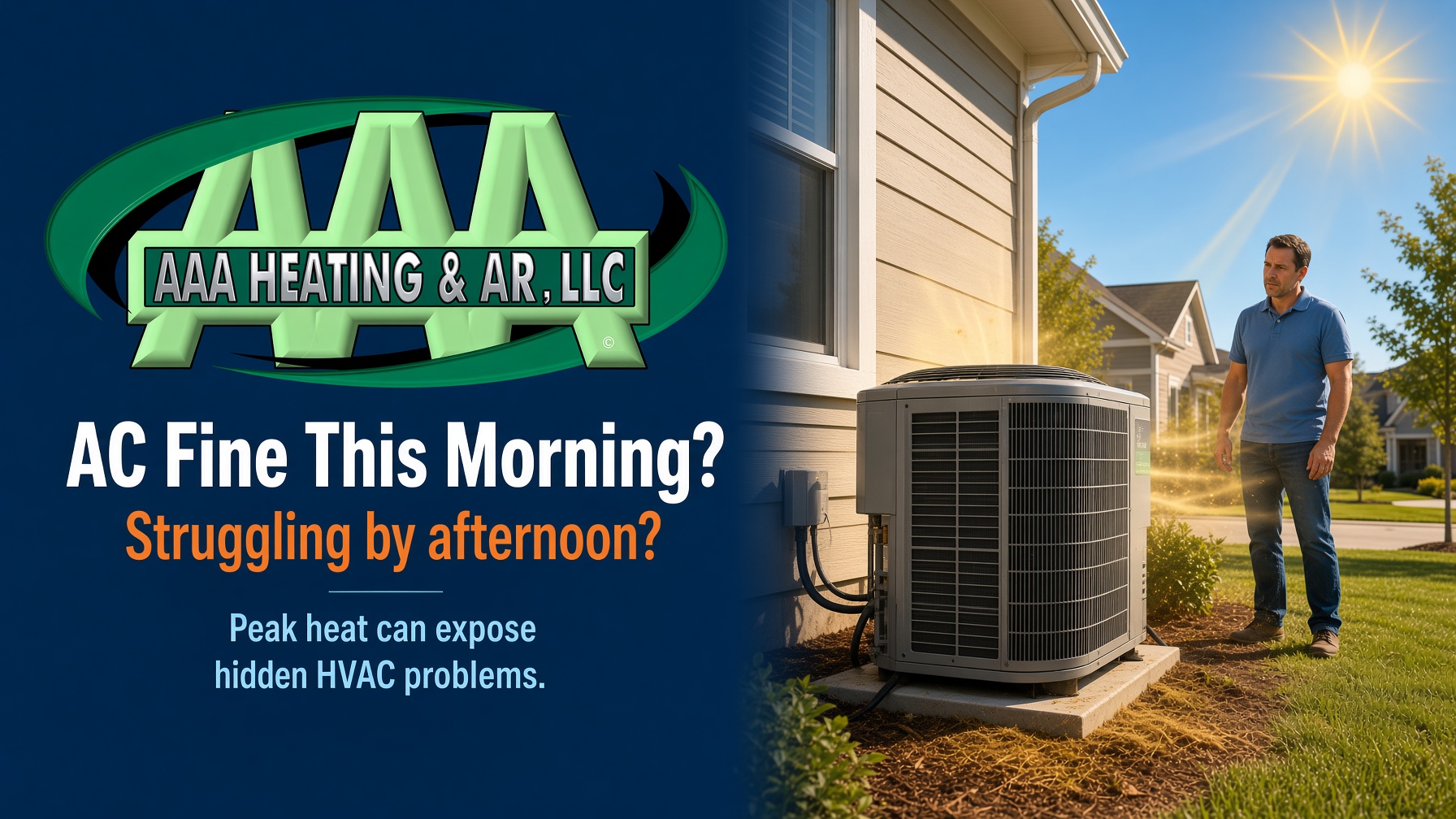
HVAC Repairs • Afternoon Heat • Midlands Home Comfort
AC Cools in the Morning but Struggles in the Afternoon? What Midlands Homeowners Should Know
If your air conditioner feels fine before lunch but loses ground during peak Midlands heat, your system may be telling you something important.
Direct Answer
If your AC cools in the morning but not in the afternoon, the system may be able to handle light cooling demand but struggle when outdoor heat, humidity, attic heat, sun exposure, and household load peak later in the day. Common causes include a dirty outdoor condenser coil, weak airflow, clogged air filter, ductwork problems, a failing capacitor or condenser fan motor, low refrigerant, poor thermostat location, or an aging system that needs HVAC repair or replacement planning. If your home keeps getting warmer after 2 PM even though the AC is running, call AAA Heating & Air for service before the problem gets worse.
AAA Heating & Air, LLC. serves homeowners across the South Carolina Midlands, including Columbia, West Columbia, Lexington, Irmo, Chapin, Cayce, Gilbert, and nearby approved service-area communities.
Why This Question Matters Today
Today’s Midlands weather is exactly the kind of setup that exposes weak AC performance. Columbia and West Columbia are both dealing with hot August conditions, highs near the upper 90s, high cooling demand, and spotty afternoon thunderstorm chances. The next couple of days are forecast to stay hot, with Thursday pushing near 101 degrees.
That matters because an air conditioner can look “fine” in the morning and still have a real problem. Morning cooling demand is lower. The sun is not yet loading the attic, upstairs rooms, windows, brick, siding, ductwork, and outdoor condenser with peak heat. By mid-afternoon, the same system has to remove heat from inside the home while also rejecting heat into hotter outdoor air.
When homeowners say, “It cools fine in the morning but quits keeping up by afternoon,” that is often the difference between a system that works under light demand and a system that cannot perform under real Midlands summer load.
Customer-Centric Bottom Line
You are not wrong to notice the pattern. If the home feels comfortable at 9 AM but climbs to 78, 80, or higher by late afternoon, the system may be struggling with heat rejection, airflow, ductwork, humidity, electrical components, or equipment age. The goal is not to blame the thermostat or tell you to “just wait until evening.” The goal is to find out why your home cannot stay comfortable when you need the AC the most.
Why an AC Loses Cooling Power in the Afternoon
Your outdoor AC unit has one major job: release the heat your system removed from inside the home. The hotter it is outside, the harder that job becomes. If the outdoor coil is dirty, blocked by yard debris, surrounded by overgrown shrubs, or struggling because the fan or capacitor is weak, the system may not reject heat efficiently.
That can show up as weak cooling, long runtime, warmer air from the vents, higher electric bills, hotter upstairs rooms, or a system that seems to recover only after the sun goes down. In other words, the AC may not be completely broken. It may simply be losing the battle during the hardest part of the day.
This is also why lowering the thermostat is not always the answer. If the system is already running continuously and cannot reach the current setting, dropping the thermostat another few degrees usually adds strain without fixing the reason the home is gaining heat.
1. Dirty outdoor coil
Grass clippings, dust, pollen, leaves, and red clay debris can restrict airflow through the outdoor condenser coil and make heat rejection harder.
2. Weak airflow inside
Dirty filters, blocked returns, blower problems, or duct restrictions can reduce the amount of conditioned air reaching the rooms that need it.
3. Duct heat gain
Ductwork in hot attics or damp crawlspaces can lose cooling power before the air ever reaches the living space.
4. Failing components
Capacitors, contactors, condenser fan motors, blower motors, refrigerant issues, and compressors can behave worse under afternoon heat load.
The Outdoor Unit Matters More Than Most Homeowners Realize
The outdoor unit is not just “the fan outside.” It is where the system releases heat from your home. If the condenser coil is dirty or airflow around the unit is restricted, the AC may run longer while removing less heat.
In the Midlands, outdoor units take a beating. Summer storms blow leaves and debris around the condenser. Lawn crews can throw grass clippings into the coil. Pollen and dust collect on the fins. Shrubs can grow too close. Red clay dust can settle around the base. All of those things can reduce the system’s ability to breathe.
A clean, open outdoor unit helps the AC reject heat more effectively. A dirty or blocked outdoor unit forces the system to work harder at the exact time of day when outdoor conditions are least forgiving.
AC losing ground after lunch?
If your AC cools in the morning but not in the afternoon, AAA Heating & Air can inspect the outdoor unit, airflow, coil condition, refrigerant performance, ductwork, thermostat setup, and system operation.
Common Reasons Your AC Cools Early but Struggles Later
A dirty or blocked condenser coil
When the outdoor condenser coil is dirty, the AC cannot release heat as efficiently. That may not be obvious in the morning, but it can become very obvious when outdoor temperatures climb into the upper 90s.
A dirty air filter
A dirty filter restricts airflow. Restricted airflow can reduce comfort, make the system run longer, increase energy use, and contribute to equipment strain. During heavy summer runtime, filters can load up faster than homeowners expect.
A weak capacitor or condenser fan motor
Some electrical components inside HVAC equipment show their weakness under heat and load. A capacitor or fan motor may seem fine early in the day but struggle when the outdoor unit is hot and the system is running hard. Homeowners should not open electrical compartments or test capacitors themselves.
Low refrigerant or refrigerant-flow problems
If the system has a refrigerant problem, it may run but fail to remove enough heat from the home. Refrigerant work requires trained HVAC service. Do not attempt to add refrigerant or diagnose sealed-system issues yourself.
Ductwork problems
Leaky, crushed, disconnected, undersized, or poorly insulated ductwork can make the system look like the problem when the real issue is delivery. The AC may create cool air, but that air may not reach the rooms that need it.
Thermostat location or settings
A thermostat near direct sun, a heat-producing appliance, a supply vent, or an unrepresentative hallway may not reflect what the rest of the home feels like. Fan settings can also affect humidity and comfort. For normal cooling, the fan should usually be set to AUTO unless a technician recommends otherwise.
System age or undersized performance
An aging system may still cool during lighter demand but fail during peak heat. A system that was not properly sized, was installed without strong duct design, or has lost performance over time may struggle every hot afternoon.
Safe Homeowner Checks Before You Call
These are safe observations and simple checks. Do not open electrical panels, remove sealed HVAC covers, touch capacitors, handle refrigerant, bypass controls, or keep running the system if you see ice forming.
- Check the air filter and replace it if it is dirty.
- Make sure all supply vents and return grilles are open and not blocked by furniture, rugs, curtains, or boxes.
- Set the thermostat to COOL and the fan to AUTO for normal cooling operation.
- Look at the outdoor unit from a safe distance and make sure shrubs, grass, leaves, and stored items are not blocking airflow.
- Make sure the outdoor unit has room to breathe around the sides and above the fan discharge.
- Look for visible ice on refrigerant lines or near the indoor coil area. If you see ice, turn the system off and call for service.
- Notice whether the problem starts around the same time each day, especially between 2 PM and 6 PM.
- Write down which rooms are hottest, whether airflow is weak, and whether the outdoor unit sounds different in the afternoon.
What Not to Do
Do not keep lowering the thermostat if the system is already running nonstop and losing ground. That usually does not solve the cause.
Do not spray high-pressure water into the outdoor unit, bend the coil fins, use harsh chemicals, or remove the fan grille unless you are trained to do so. Gentle debris clearing around the unit is different from deep coil cleaning.
Do not open electrical compartments, touch capacitors, handle wiring, or repeatedly reset breakers. If a breaker trips, if the outdoor unit hums but does not start, if the fan stops, or if wiring looks damaged, call for service. If the concern appears to involve the home’s electrical panel or breaker safety, AAA Heating & Air’s Electrical Division can help evaluate that electrical side appropriately.
Do not add refrigerant. Low refrigerant is not a homeowner maintenance task. It usually means the system needs proper diagnosis.
HVAC Repairs
If the AC loses cooling in the afternoon, a repair visit can help identify condenser, airflow, refrigerant, capacitor, fan motor, thermostat, or system-performance issues.
HVAC Maintenance
Maintenance helps keep coils, filters, drains, electrical components, and airflow under review before peak heat exposes small problems.
Ductwork Replacement
If the AC is making cool air but hot rooms keep returning, damaged or poorly insulated ductwork may be part of the comfort problem.
When This Becomes a Repair Call
Call for HVAC service when the system runs but the home gets warmer through the afternoon, when upstairs rooms stay hot, when vent air feels weak or lukewarm, when the outdoor unit sounds different, when ice appears, when the system short cycles, when breakers trip, or when the same comfort problem returns every hot day.
The best repair call is not just “make it cold again.” It should answer the customer’s real question: why is my home comfortable part of the day but not when my family needs cooling the most?
AAA Heating & Air can evaluate the full system, including the outdoor unit, coil condition, airflow, refrigerant performance, blower operation, thermostat settings, ductwork, drain condition, and equipment age. That gives homeowners clear options instead of guesswork.
Frequently Asked Questions
Why does my AC work in the morning but not in the afternoon?
Morning cooling demand is lower. Afternoon heat adds sun exposure, attic heat, duct heat gain, outdoor condenser load, and higher indoor demand. If the system has airflow, coil, refrigerant, ductwork, or component problems, those issues may show up most clearly after lunch.
Can a dirty outdoor AC unit make the house hot?
Yes. The outdoor unit has to release heat from the home. If the condenser coil is dirty or blocked, heat rejection becomes harder and cooling performance can drop during peak heat.
Should I hose off my outdoor AC unit?
Homeowners may be able to gently clear loose debris around the unit, but deep coil cleaning, chemical cleaning, bent fins, electrical access, and component testing should be handled by a trained HVAC technician. Always turn equipment off before any safe homeowner cleaning around the unit.
Why is my upstairs hotter in the afternoon?
Upstairs rooms often gain more heat from attics, rooflines, sun exposure, and ductwork running through hot spaces. Weak airflow, duct leakage, poor insulation, or system performance problems can make the upstairs fall behind quickly.
Is it normal for the AC to lose a few degrees during extreme heat?
Some systems may struggle slightly during extreme heat, especially in older homes. But if household temperatures keep climbing, rooms become uncomfortable, airflow is weak, or the problem happens every hot day, it should be evaluated.
When should I call AAA Heating & Air?
Call when your AC cools in the morning but cannot keep up in the afternoon, the home gets warmer while the system is running, upstairs rooms stay hot, airflow feels weak, the outdoor unit sounds wrong, breakers trip, ice appears, or your electric bill climbs without clear reason.
Weather and HVAC Reference Sources
Weather forecasts and HVAC guidance can change. Homeowners should continue checking current local weather alerts and should use qualified HVAC help for refrigerant, electrical, deep-cleaning, compressor, capacitor, blower, ductwork, or system-performance concerns.
Final Recommendation
Do not judge AC performance only by the morning.
If your AC cools early but loses ground during peak Midlands heat, there may be a real HVAC issue hiding behind the weather. Let AAA Heating & Air inspect the system and give you clear repair, maintenance, ductwork, or replacement options.