


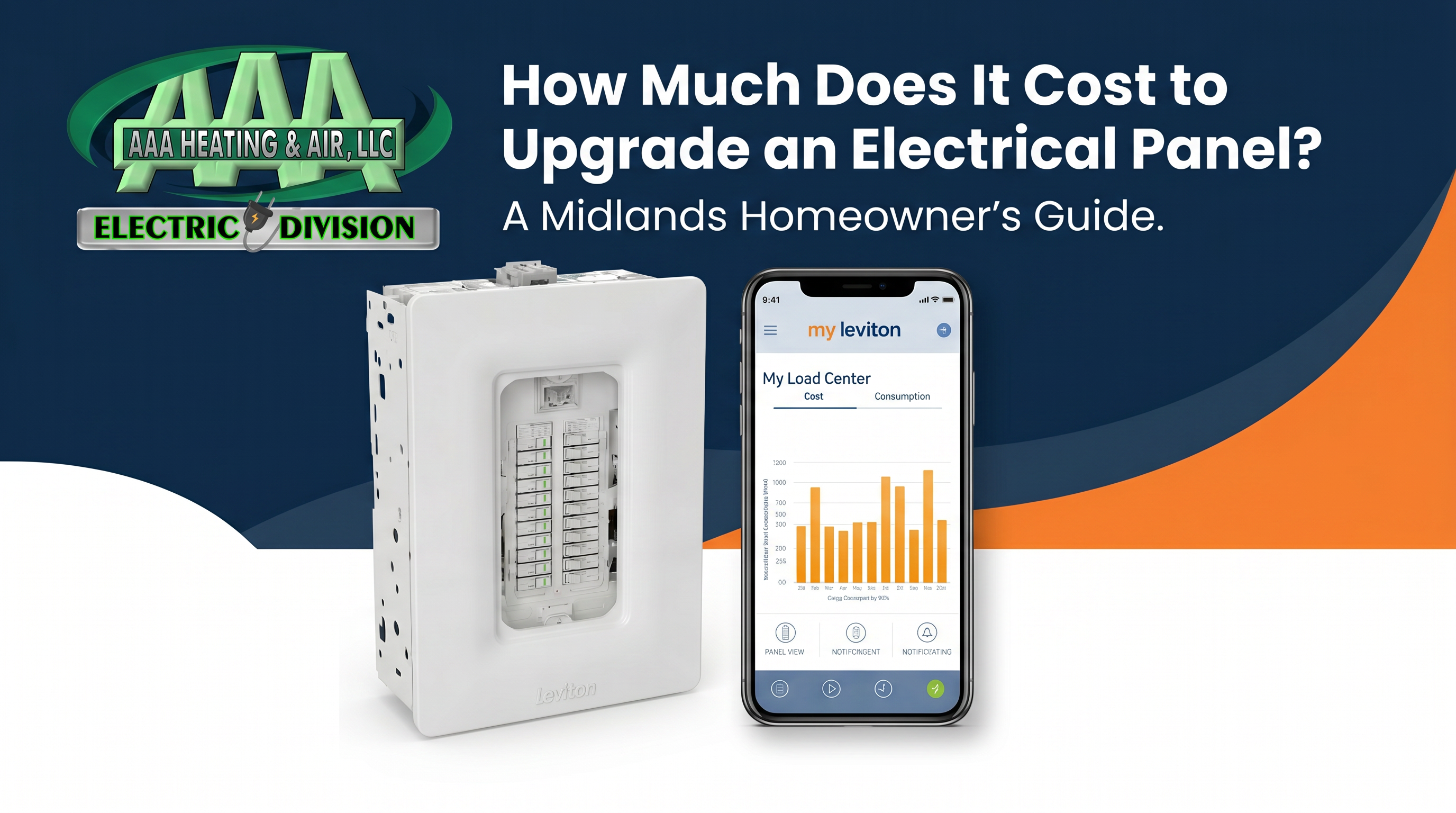
How Much Does It Cost to Upgrade an Electrical Panel?
A practical cost guide for Midlands homeowners considering a breaker box upgrade, panel replacement, added circuits, EV charger preparation, or safer electrical capacity.
In This Guide
Direct Answer
The cost to upgrade an electrical panel depends on the size of the panel, the condition of the home’s wiring, whether the project is a true service upgrade, permit requirements, utility coordination, grounding updates, panel location, and any added circuits or electrical loads. Many straightforward residential panel upgrades are commonly discussed in the low-thousands, while more involved 200-amp upgrades or older-home correction work can cost significantly more. The only accurate way to price the job is to inspect the existing panel, load demand, wiring condition, grounding, and code-related requirements.
Electrical panel upgrades are one of those home projects where the question sounds simple, but the answer depends heavily on the house. A newer home with an accessible panel and modern grounding may be a very different project than an older Midlands home with a crowded breaker box, outdated service equipment, questionable wiring, or limited room for additional circuits.
For homeowners in Columbia, West Columbia, Lexington, Irmo, Chapin, Cayce, and surrounding Midlands communities, the real question is not just “What does a panel upgrade cost?” The better question is: “What does my home need to safely support the way my family uses electricity today?”
What Affects the Cost of an Electrical Panel Upgrade?
Panel upgrade costs vary because every home’s electrical setup is different. The final number depends on whether the work is a simple panel replacement or a broader service upgrade. Here are the most common cost drivers:
Need Real Numbers for Your Home?
Panel pricing depends on the home, the current electrical service, and what you want the system to support. Schedule an evaluation and get clear options before you commit.
So What Is a Reasonable Budget Range?
As a general planning range, many straightforward residential panel replacements or upgrades fall somewhere in the low-thousands. More involved 200-amp upgrades, older-home correction work, added circuits, relocation, grounding updates, or meter/service work can push the project higher.
That range is not a quote. It is a budgeting starting point. Because electrical work differs from home to home, the safest and most useful next step is to have the system evaluated and priced based on your actual electrical conditions.
When Should You Consider Upgrading Your Home’s Electrical Panel?
You should consider an electrical panel evaluation when your home’s electrical demand is growing, when the panel is showing warning signs, or when you are planning a major home improvement that needs additional safe capacity.
- You are adding a new HVAC system, heat pump, mini-split, or other large equipment.
- You want to install an EV charger or dedicated high-load circuit.
- You are remodeling a kitchen, finishing a room, building an addition, or adding a workshop.
- Your current panel is full, crowded, or dependent on questionable modifications.
- Your home still has a fuse box or an older breaker panel that may not match modern electrical use.
- You are seeing repeated breaker trips, flickering lights, buzzing, heat, rust, or burning smells around electrical equipment.
Signs of an Outdated or Failing Electrical Panel
An electrical panel is the control center for your home’s electrical circuits. When it is overloaded, damaged, outdated, or failing, the warning signs should not be ignored.
Call promptly if you notice these symptoms:
- Breakers that trip repeatedly.
- A breaker that will not reset or feels loose.
- Lights that dim or flicker when major equipment starts.
- Buzzing, crackling, or sizzling sounds near the panel.
- Warmth, scorch marks, discoloration, or a burning smell.
- Rust, corrosion, moisture, or signs of water intrusion.
- A panel that is packed with no room for proper circuit expansion.
- Older equipment or outdated panel components.
Do not remove the panel cover or attempt internal electrical troubleshooting yourself. A homeowner can observe symptoms, check whether a breaker has tripped, and write down when the problem happens. Diagnosis and repair inside the panel should be handled by a trained electrical professional.
How Long Does a Residential Electrical Panel Last?
A residential electrical panel can often last for decades, but age alone is not the only factor. The actual condition of the equipment, moisture exposure, heat damage, breaker wear, installation quality, and the home’s electrical demand all matter.
A panel that is 25 to 40 years old may still be working, but it may no longer be the right fit for the way a modern Midlands home uses electricity. Older homes may now be supporting central HVAC, dehumidification demands, larger appliances, home offices, outdoor equipment, and modern electronics that were not part of the original electrical plan.
Panel Upgrade vs. Panel Replacement: What Is the Difference?
Homeowners often use “panel upgrade” and “panel replacement” as if they mean the same thing, but they can describe different scopes of work.
What Can You Check Safely Before Calling?
Electrical panels are not a DIY repair area, but before you call, there are a few safe observations a homeowner can make:
- Look at the main breaker label to see whether the panel appears to be 100 amp, 150 amp, or 200 amp.
- Make a list of major equipment in the home, including HVAC, water heater, range, dryer, generator equipment, EV charger, or workshop tools.
- Write down which breakers trip and what was running when they tripped.
- Note whether flickering happens only when a major system starts or whether it happens randomly.
- Look for visible rust, discoloration, missing labels, or signs of overheating without touching internal components.
- Check whether the panel area is accessible and free from stored items before a service visit.
Do not remove the panel cover. Do not touch service wires. Do not attempt to add breakers or modify wiring. If you smell burning, see smoke, hear active arcing, or feel heat at electrical equipment, treat it as urgent.
Why Panel Capacity Matters for HVAC, Generators, and Modern Homes
Electrical demand is not just about lights and outlets anymore. A modern Midlands home may have central heating and cooling, smart devices, multiple refrigerators or freezers, home office equipment, high-load kitchen appliances, outdoor equipment, and plans for backup power. When the panel cannot safely support the load, the home may experience nuisance trips, limited expansion options, or safety concerns.
If you are planning a major comfort or backup-power improvement, it is smart to evaluate the electrical panel before installation day. Homeowners considering new comfort equipment can review Residential Heating and Cooling Replacement. Homeowners considering backup power can also review Standby Generator Services.
Panel capacity, breaker compatibility, grounding, disconnects, and load planning should be addressed before adding high-demand equipment. That planning helps avoid surprises and gives the homeowner clearer options.
Why Call AAA Heating & Air’s Electrical Division?
AAA Heating & Air’s Electrical Division helps Midlands homeowners evaluate panel condition, breaker behavior, electrical load, safety concerns, and planned upgrades. That matters because a panel upgrade is not just about replacing a box on the wall. It is about protecting the home and supporting the way the family actually uses electricity.
If your home is older, your breaker panel is crowded, your lights flicker when major equipment starts, or you are planning a large electrical upgrade, ask for a professional evaluation before assuming the smallest repair or the biggest replacement is the right answer. The best next step should be based on the home’s actual electrical condition.
Electrical Panel Upgrade FAQ
How much does it cost to upgrade to a 200-amp panel?
A 200-amp panel upgrade can vary depending on whether the project is a simple panel change or a full service upgrade. Meter work, grounding updates, wiring corrections, permits, panel location, and added circuits can increase the cost. Scheduling an evaluation is the best way to get an accurate number for your home.
Is an electrical panel upgrade worth it?
It can be worth it when the existing panel is unsafe, outdated, full, damaged, unreliable, or unable to support planned electrical loads. It may also be important before adding an EV charger, standby generator, major HVAC equipment, or a remodel.
Can I upgrade my electrical panel myself?
No. Electrical panel work involves service power, code requirements, grounding, breaker compatibility, and serious shock and fire hazards. This work should be completed by a trained electrical professional.
What are the warning signs that my panel may be failing?
Repeated breaker trips, buzzing, burning smells, scorch marks, warm surfaces, loose breakers, rust, and flickering lights are all warning signs that a panel evaluation may be needed.
How long does an electrical panel usually last?
Many panels can last for decades, but lifespan depends on equipment condition, moisture exposure, heat, electrical demand, installation quality, and whether the panel still meets the home’s needs. Older panels should be evaluated if the home’s electrical load has increased.
Plan Before the Overload
If your panel is outdated, crowded, tripping, buzzing, showing signs of heat, or not ready for new electrical demand, contact AAA Heating & Air’s Electrical Division for safe, professional troubleshooting and upgrade guidance.
Written by: Jared M. Sewell
AAA Heating & Air, LLC. | 3521 Edmund Highway, West Columbia, SC 29170 | License #M-190890
Serving Columbia, West Columbia, Lexington, Irmo, Chapin, Cayce, and surrounding Midlands communities.